Why train with KMT?
KMT is an established, large-scale regional ITT provider with a strong track record of supporting career changers move into teaching. KMT has a wide school network and offers high-quality mentoring, and varied placements across Kent and the South London fringe.
KMT offers training in subject areas including:
- Citizenship
- English
- Biology
- Modern Foreign Languages
- RE
- Dance
- Drama
- Geography
KMT currently has teacher training locations in areas including:
- Tonbridge
- Sevenoaks
- Rye
They can also place candidates across Kent, including schools with ME postcodes, and on the South London fringe.
Eligibility and requirements
KMT requires candidates to have a degree, appropriate subject knowledge, a DBS check and valid right to work in the UK, as well as completing a satisfactory interview.
Subject knowledge should not be treated as a barrier. KMT recognises career changers often have more relevant subject knowledge than they realise.
Candidates do not need to have previous school experience before applying. KMT is able to offer school experience to prospective candidates and encourages candidates who have no school experience to take up this opportunity to experience the reality of working in a school before they apply.
Application process
Candidates will be required to complete an application which will be assessed against KMTs eligibility requirements for teacher training. Successful candidates will be invited to interview, and if successful at this stage made of aware of any conditions they will need to meet to be made an offer onto the training programme.
Once all conditions are met and the offer has been accepted a school place will be found.
Now Teach will supports candidates through this process, offering advice and guidance with applications, and preparations for interview.
Once a candidate has started the programme, there are three formal assessment points — December, April and July. These need to be successfully passed, with support provided where required.
KMT encourages applications from career changers and has often found their professional experience helps them shine throughout the process.
How Now Teach supports you
When you join Now Teach, you don’t just retrain - you join a community. Our Network connects you with others who’ve taken that step into teaching, helping you stay supported and inspired throughout the journey.
- Free expert advice to apply for teacher training
- Two years' personalised career-change support
- Lifetime membership to a national network of career changers
- Make an impact on young people's lives with your previous experience
FAQs
There’s a lot to consider when you’re thinking about becoming a teacher. So, we’ve collected answers to some frequently asked questions below. If you can’t find the answer you’re looking for, register with us and a career change specialist will be in touch.
Our events are a chance to get up-to-speed on the big issues in education and to develop relationships with other career changers in the Now Teach Network.
We offer opportunities across the year to develop your knowledge and encourage networking.
The sessions focus on a topic previous cohorts have identified as wanting to hear more about. Topics this year include Behaviour, Planning and Assessment, Subject Knowledge and Preparing for your NQT year.
We also hold an annual Now Teach Conference. This is for every Now Teacher, designed and led by career changers tailored to addressing what you need to know for when you start in the classroom and your first two years in teaching.
Your pattern will depend on whether you are on a school or provider-led training route. However, when you first start, you typically will have 6-8 hours a week contact time in class.
This will be a mixture of lessons that you observe, and lead and this balance will change over time. The rest of the time you will be planning, training and reflecting.
Contact time then increases through the school year as you progress. You will sometimes be observed by qualified teachers and sometimes co-teaching alongside an experienced teacher.
You will be asked to complete assignments as part of your teacher training course if you are completing a PGCE these will be masters level assignments.
In addition to teaching and developing your practice you should expect to engage in extra-curricular activity, form time, school duties and meetings.
Ofsted (Office for Standards in Education, Children’s Services and Skills) is a government department that inspects and regulates institutions in England providing education to learners of all ages and providers of care for children and young people.
The following list is a guide to useful acronyms to know:
DfE – The Department for Education
FE – Further Education
HOD – Head of Department
HT – Headteacher
HE – Higher Education
HEI – Higher Education Institute
ITT – Initial Teacher Training
KS – Key Stage
NARIC – National Academic Recognition Information Centre
NQT – Newly Qualified Teacher
OFSTED – The Office for Standards in Education
OTT – Overseas Trained Teacher
PGCE – Post Graduate Certificate in Education
QTLS – Qualified Teacher Learning and Skills
QTS – Qualified Teacher Status
SKE – Subject Knowledge Enhancement
SCITT – School Centred Initial Teacher Training
STEM – Science, Technology, Engineering and Mathematics
SD – School Direct
SEND – Special Educational Needs and Disabilities
SENco – Special Educational Needs Co-ordinator
TA – Teaching Assistant
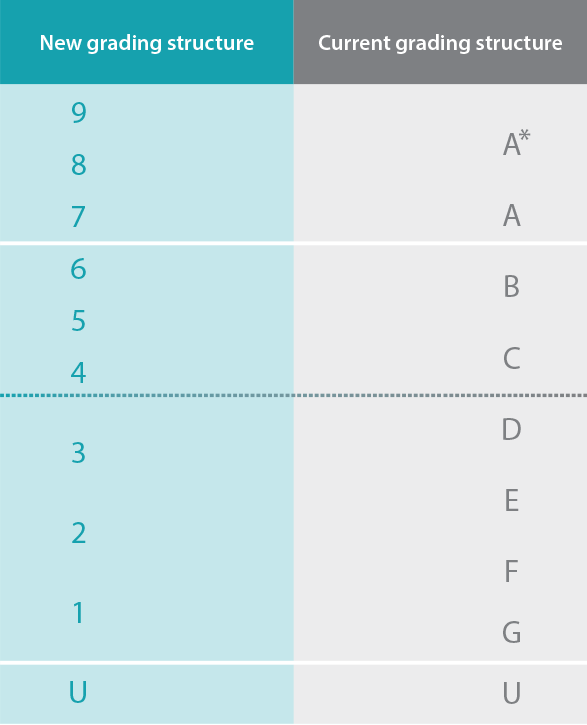
GCSEs in England have been reformed to keep pace with universities’ and employers’ demands. The new grades have replaced letters with numbers with 9 being the highest grade.
They are based on new and more demanding subject content but are still suitable for the same wide range of abilities. The new grade scale makes it clear to everyone that students have studied the new GCSEs.
It also has more higher grades compared to the old A to G grades, to give sixth forms, colleges, universities and employers the opportunity to better distinguish between students of different abilities.
For a table on equivalence see here.
Teaching is a job like few others. It can be stressful, rewarding, challenging, and funny, often within the same hour.
Our founder Lucy Kellaway has documented her experience in training to become a teacher and we would recommend her book: Re-Educated.
We would also recommend reading some of the case studies of our participants.