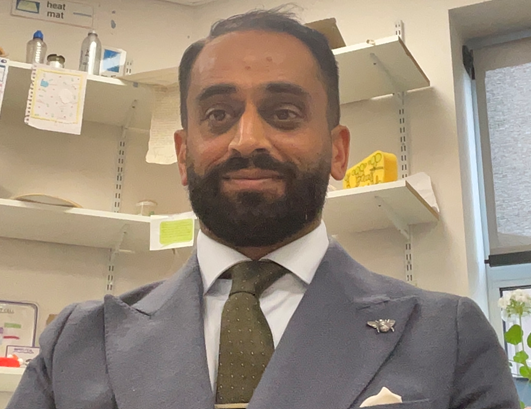
What was your motivation behind exploring a career change?
After nearly 20 years working in industry, innovation and business, I reached a point where I began thinking about what I wanted the next chapter of my professional life to contribute. I had enjoyed a rewarding career solving technical problems, developing innovations and leading people, but increasingly I wanted to do something where the impact was more human, direct and lasting.
Teaching appealed to me because it brought together three things that have always mattered to me: science, curiosity and developing others. I was also attracted by the prospect of starting again. Having spent years being the experienced person in the room, I knew I would be returning to the position of a novice.
Rather than finding that daunting, I found it genuinely exciting. There is something quite liberating about acknowledging how much you still have to learn.
Why did you want to become a teacher?
Science has shaped much of my life, both academically and professionally, and I wanted to share that enthusiasm with young people. I believe science should be accessible to everyone, not just those who already see themselves as academically able or naturally inclined towards STEM.
I want pupils to recognise that science is not simply a collection of facts and equations to memorise. It is a way of questioning, investigating and making sense of the world around them.
Having seen where a scientific education can lead, I am particularly passionate about raisin aspirations and helping pupils recognise opportunities they might never have considered. Ultimately, I want to be the kind of teacher who not only helps pupils understand chemistry but also gives them the confidence to ask questions, challenge ideas and believe in their own potential.
How have you been able to apply your previous work/life experiences when teaching?
My previous career taught me the importance of understanding people, solving problems and adapting my approach to different situations. What I hadn’t fully appreciated was just how valuable those experiences could be in a classroom.
One of my most meaningful experiences so far has been supporting a young girl from Afghanistan who had arrived in the UK under very challenging circumstances. She faced significant language barriers, which made accessing the curriculum particularly difficult.
Drawing on my own linguistic and cultural understanding, I was able to communicate with her in Urdu, using visual representations, worked examples and carefully introduced English vocabulary to help bridge the gap in her learning.
What struck me most wasn’t simply the academic progress, but the difference that feeling understood could make to her confidence and willingness to engage. A member of the school’s senior leadership team remarked on how happy she had seemed. It was a moment that stayed with me.
The work was subsequently recognised with a Notable Performance Award, but the real reward was seeing the difference that a thoughtful, individual approach could make. That experience reinforced something I am increasingly learning teaching isn’t simply about knowing your subject or delivering a well-planned lesson. It is about recognising the individual behind the pupil, understanding the barriers they face and finding ways to help them succeed.
Twenty years in industry gave me experience in leadership, communication, and problem solving. Teaching is giving those skills an entirely new purpose and reminding me that sometimes the most meaningful impact begins with something as simple as making someone feel understood.
What are the things you enjoy/look forward to most about being/becoming a teacher?
Without question, it is the curiosity of young people. I particularly enjoy the unexpected questions, the ones that make you stop and think about something you may have taken for granted for years. Sometimes the simplest question reveals the deepest thinking. I have even been developing a ‘Curiosity Box’ for my Year 7 pupils, giving them an opportunity to ask questions that might fall outside the immediate lesson. I want them to know that their curiosity matters, even when we cannot explore every question there and then.
I am also discovering how much I enjoy the intellectual challenge of teaching itself. Planning a lesson, anticipating misconceptions, finding different ways to explain a concept and then reflecting on what pupils have actually learned requires considerable thought.
One of the most important lessons for me has been recognising that an engaged classroom does not necessarily mean that learning has occurred. I am becoming increasingly interested in how we check understanding, revisit knowledge and ensure that what pupils learn stays with them.
Looking ahead, I am particularly excited about building relationships with pupils over time, watching their confidence develop and, hopefully, playing some small part in shaping their futures. I want to become an educator who raises both attainment and aspiration.
How is/has the Now Teach Network supported you throughout your teacher training?
Now Teach has been part of my journey from the very beginning. Before starting my PGCE, Wendy Proctor was instrumental in helping me navigate the application process and prepare for interviews. Her encouragement, guidance and coaching were invaluable at a point when I was contemplating a significant professional transition.
Since beginning my training, Tasnia Choudhury has continued that support, whether through practical guidance, reassurance or simply being there when I need to talk something through or have the occasional moan!
The CPD opportunities and network events have also been valuable, particularly because they connect me with people who understand the unusual experience of moving from an established career into a profession where you suddenly have so much to learn. There is something reassuring about being surrounded by people who have made similarly significant decisions about their lives.
Teacher training can be demanding, and the transition from experienced professional to trainee teacher is certainly humbling. Having a network that understands both what you bring to teaching and the challenges of starting again makes an enormous difference.
What would you say to those who are considering a career change to teaching?
I would say go into it with an open mind, a willingness to learn and a healthy dose of humility. Your previous experience matters. The knowledge, judgement, resilience and perspective you have developed throughout your career are valuable. But teaching is a profession in its own right, with its own body of knowledge and expertise, and that deserves respect.
Be prepared to listen, observe, accept feedback and occasionally get things wrong. I have learned as much from lessons that did not go quite as planned as I have from those that did. I would also encourage people not to underestimate how stimulating teaching can be. Every day presents new challenges, and young people have an extraordinary ability to make you reconsider things you thought you understood.
Above all, do not think of changing careers as starting from nothing. You are bringing a lifetime of experiences with you, but you are also giving yourself permission to grow in an entirely new direction.
For me, that has been one of the most rewarding aspects of the journey so far. If the idea of teaching keeps returning to you, I would encourage you to explore it. You may discover that the next chapter of your career is not about what you have already achieved, but about what you can help others achieve.
Sign up to our newsletter
Get regular updates from Now Teach. Including our blog, events announcements and latest news.